Sample Problem Statement
Design a vertical gas-liquid separator for separation of fuel gas bubbles entrained in water flow.
Flow rate of water = 182 m3/hr
Entrained Flow of fuel gas = 32 m3/hr
Operating temperature of separator = 250C
Operating pressure of separator = 0.2 barg (near atmospheric)
Separation efficiency required is to remove 80% of gas bubbles above the size of 10o microns.
Fuel gas properties can be approximately taken as properties of ethane.
Step 1
Water density at 250C = 994.72 kg/m3
Water viscosity at 250C = 0.9 cP
For fuel gas properties,
Molecular weight of ethane = 30 gm/gmole
Fuel gas density at 250C = 1.45 kg/m3
Fuel gas viscosity at 250C = 0.0069 cP
Step 2
The gas liquid separation can be modeled using Stokes law. Where gas bubble terminal velocity is expressed as,
The subscripts L and G stand for liquid phase and vapour phase respectively. And the gas bubble diameter Dp is described in microns. Thus, using Dp = 10o micron,Vt= 6.02 × 10⁻³m/s
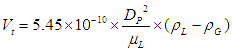
(It should be noted that the use of Stokes law is valid only for Reynolds number lower than 2.EnggCyclopedia’s vertical degasser sizing calculatoruses an iterative procedure for calculation of Reynolds number and terminal velocity to make sure that the correct correlation is used. For higher Reynolds number, other equations govern the phase separation)
Here Reynolds number is calculated below,
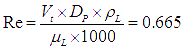
As Re < 2 Stokes law is valid.
Step 3
A tentative H/D ratio needs to be fixed for the vessel. Since the diameter of vessel (D) and TL-TL height of the vessel (H) are unknown, it makes it necessary to put a handle between then in the form of H/D ratio. Normally this ratio varies from 2 to 5. Here we select 2.5.
Step 4
The residence time requirement between high water level (HLL) and low water level (LLL) remains to be determined. This residence time should be sufficient to allow the separation of gas bubbles from the liquid. In other words residence time available should be more than separation time requirement for gas bubbles. For gas bubble time required for escape can be said to be the time required to travel from LLL to HLL.
Separation time = (HLL-LLL)/Vt
Residence time = (HLL-LLL) X π X D2X 3600 / 182 (residence volume divided by volume flow)
D = H / 2.5 (from H/D ratio)
The minimum requirement for separation is that residence time should be greater than or equal to separation time and we have to evaluate two variables, (HLL-LLL) and H, to satisfy this requirement.
This is done in an iterative way, minimum separation requirements between various levels in vessel, usually followed in the industry, suggest that the minimum vessel height should be between 1m to 1.5m. Also, normally minimum spacing of 300-500 mm is desirable between HLL and LLL, as common practice in industry.
Thus for the iterations, both the unknowns (HLL-LLL) and H are increased starting from 1m and 0.3 m respectively, in equal steps until the residence time is greater than separation time. It should be noted that the diameter is also increased in each of the iterative step.
All these iterative calculations are performed inEnggCyclopedia’s vertical degasser sizing calculatorand the result is,
Diameter = 3.30 m
Height = 8.25 m
Vessel volume = 89.33 m3


